
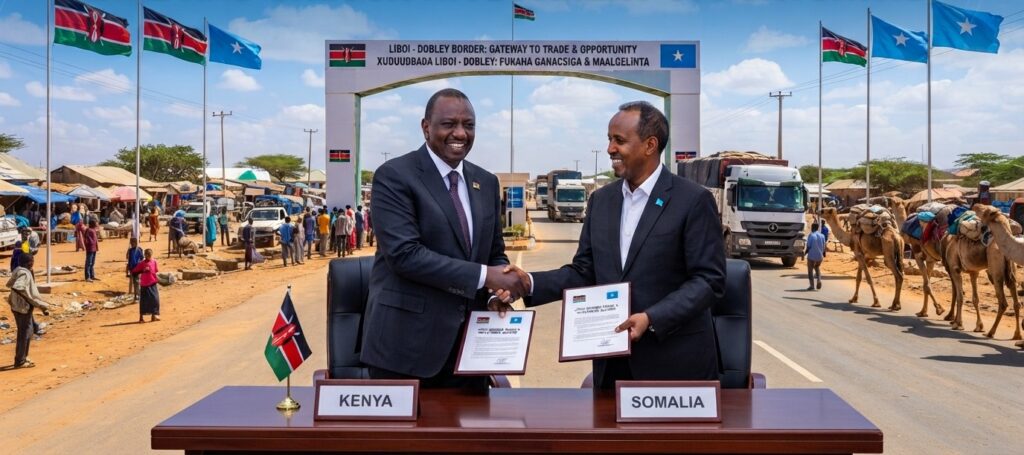
Kenya and Somalia are working to improve cross-border trade, streamline customs procedures, and create new investment opportunities as the two neighbours seek to deepen economic cooperation.
The discussions were held during bilateral talks between Kenya’s Cabinet Secretary for Investments, Trade and Industry, Lee Kinyanjui, and Somalia’s Minister of Commerce and Industry, Gamal Mohamed Hassan, on the sidelines of the Horn of Africa Trade Ministers’ Meeting in Addis Ababa, Ethiopia.
Kinyanjui said Kenya and Somalia have significant potential to expand economic ties due to their shared border, strategic location along the East African coast, and complementary economic opportunities.
“Kenya and Somalia are close neighbours with huge potential for trade and investment,” Kinyanjui said, adding that border systems should be transformed from barriers into platforms that support business growth and regional integration.
The talks focused on strengthening bilateral trade, improving border and customs processes, and expanding cooperation in key sectors including agriculture, livestock, fisheries, manufacturing, and logistics.
The engagement comes as both countries seek to maximise the benefits of Somalia’s membership in the East African Community (EAC). Somalia officially joined the regional bloc in March 2024, expanding the EAC’s footprint into the Horn of Africa and strengthening opportunities for regional trade and connectivity.
Efforts to improve trade facilitation are also being supported through regional initiatives aimed at reducing non-tariff barriers, improving transport corridors, and enhancing the movement of goods across East Africa.
Renewed Focus on Border Reopening
The discussions come amid renewed calls for the reopening of the Kenya-Somalia border, particularly at the Liboi crossing in Garissa County, which has remained largely closed due to security concerns linked to militant activity.
Local leaders and traders have continued to advocate for the reopening of formal border points, arguing that improved border access would support legitimate commerce, create economic opportunities, and enable better regulation of cross-border trade.
Kenya’s government has previously indicated plans to reopen sections of the border following security assessments, while strengthening measures to address security risks.
Health Cabinet Secretary Aden Duale has also argued that prolonged border closures have not stopped the movement of goods but have instead contributed to informal trade channels.
For businesses operating across Kenya and Somalia, improved customs systems and more predictable border operations could reduce trade costs, minimise delays, and encourage greater private sector participation.
Beyond border trade, both countries are positioning agriculture, livestock, fisheries, manufacturing, and logistics as priority areas for increased investment and economic collaboration.
As Kenya and Somalia work to strengthen regional integration, improved trade links could play a key role in unlocking new business opportunities, supporting local economies, and driving growth across the Horn of Africa.ment will require more than natural resources alone. Developing the infrastructure, technical capabilities, and skilled workforce needed to support expansion will be critical to translating energy growth into broader economic opportunities.
The country’s ability to attract sustained investment could have significant implications for job creation, industrial development, and Africa’s wider energy transition.
With global investors increasingly evaluating markets based on stability, capacity, and long-term partnerships, Nigeria’s next phase of energy development will depend on how effectively it converts its resource advantage into sustainable economic growth.