Employer of record pricing can look straightforward when it arrives in a proposal: a monthly fee, a payroll figure and perhaps a short list of included services. For a CFO, however, the headline number is only the starting point.
The real question is what the organisation will spend from onboarding to termination, and whether the quoted fee reflects the complexity of employing people in the countries where the business operates.
An EOR can remove the need to establish a local entity, but that does not mean every employment related cost disappears. Payroll taxes, statutory contributions, benefits, foreign exchange movements, employee changes and additional administrative requests can all affect the final bill.
For finance leaders, understanding these details before signing a contract can prevent an apparently attractive arrangement from becoming an expensive one.
Look Beyond the Monthly Service Fee
The first thing to examine in EOR pricing is what the base fee actually covers.
Some providers charge a fixed monthly amount per employee. Others use a percentage of payroll. Some combine both approaches. There may also be separate charges for onboarding, offboarding, visa support, recruitment, expense processing, payroll changes or special compliance requests.
None of these structures is automatically wrong. The issue is whether the commercial model matches the organisation’s workforce plans.
Consider a company hiring 20 employees across four African markets. A low monthly fee might initially appear attractive, but if every new hire, termination or immigration request attracts an additional charge, the annual employer of record cost could be significantly higher than the original calculation.
A CFO should therefore ask for the expected annual cost under realistic operating conditions, not simply the monthly headline price.
Understand What “All In” Really Means
The phrase “all in” deserves careful attention.
In some proposals, it means the provider has bundled most routine administration into one fee. In others, it may refer only to the EOR management charge while statutory employment costs remain separate.
This distinction matters.
A useful employer of record pricing review should separate the costs that are genuinely fixed from those that move with salary, headcount, government requirements or employee circumstances.
Ask specifically whether the quotation includes payroll processing, statutory filings, employee onboarding, termination administration, benefits administration and routine HR support. Then identify the items that sit outside the package.
That simple exercise can expose the difference between a predictable cost and a variable one.
Statutory Costs Still Belong in the Budget
An EOR does not eliminate the underlying cost of employment.
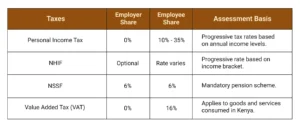
Employers may still need to account for social security contributions, pension obligations, payroll taxes, insurance, statutory benefits and other employer liabilities depending on the country.
These costs can vary considerably across jurisdictions. They can also change when an employee’s salary, benefits or employment status changes.
That means EOR pricing should never be assessed independently of the local employment framework.
For a CFO managing several African markets, this is particularly relevant. A workforce of ten people in one country may have a very different statutory cost profile from ten employees spread across five countries.
Foreign Exchange Can Quietly Change the Numbers
Currency movement is another area that deserves attention.
If the client funds payroll in one currency while employees receive salaries in another, exchange rate movements can affect the amount the organisation ultimately pays. Bank charges and conversion spreads may also enter the equation, depending on the payment structure.
This is one reason employer of record pricing should be modelled using actual payroll scenarios rather than a single exchange rate.
Suppose an organisation budgets for a regional team using a fixed dollar assumption. If local currencies move materially during the year, the amount required to fund payroll can change even when employee salaries remain unchanged.
The CFO needs to know who carries that exposure and how the provider handles currency conversion.

Headcount Changes Can Affect Total Cost
Workforce plans rarely stay static.
An organisation may hire five employees in one quarter, add ten more during expansion and then reduce the team when a project ends. Each movement can have financial consequences.
Some EOR pricing models charge the same monthly fee regardless of activity. Others may apply different rates depending on headcount or contract duration.
Termination costs deserve particular scrutiny because local employment rules can require notice payments, severance, accrued leave payments or other statutory obligations.
Before approval, finance teams should model at least three scenarios: steady headcount, rapid growth and workforce reduction. This gives a clearer view of the potential cost range.
Benefits Can Be a Hidden Variable
Employee benefits can also complicate an apparently simple quotation.
Health insurance, pension arrangements, allowances and other benefits may be handled through the EOR. However, the price may depend on employee age, location, coverage level or provider availability.
This does not make benefits an unwanted cost. They are part of the employment package. The issue is transparency.
When comparing employer of record pricing, CFOs should ask for a clear explanation of how benefits are priced and whether employees can choose between different plans.
A detailed breakdown also makes it easier to compare providers on a like for like basis.
Ask About Changes, Exceptions and Extras
The cheapest arrangement on paper may not remain the cheapest once the workforce becomes more active.
A salary adjustment, new employee benefit, immigration request or change to an employment contract may trigger an additional fee. These charges can be reasonable, particularly where they involve substantial specialist work, but they should be visible before the contract is signed.
This is where employer of record pricing needs to be treated as a commercial model rather than a single number.
Finance teams should review the provider’s fee schedule and identify the activities most likely to occur during the year. A business expanding rapidly across Africa will have different requirements from a company employing two remote workers.
Compare Providers on Total Cost, Not Just Price
A proper comparison should consider service coverage, local expertise, response times, compliance support and the likelihood of additional charges.
A provider with a slightly higher monthly fee may ultimately offer better value if the contract covers more routine activity and gives the finance team stronger cost predictability.
Conversely, a low fee can become less attractive when every exception is separately charged.
This is why employer of record pricing should be evaluated alongside the operating model the provider offers. The right question is not simply, “Who is cheapest?” It is, “What will this workforce actually cost us over the next 12 months?”
Build A Realistic Cost Model Before Signing
Before approving an EOR agreement, the finance team should build a simple annual forecast.
Start with gross salaries. Add employer statutory costs, benefits, EOR fees, expected onboarding and termination activity, immigration requirements where relevant, currency assumptions and a reasonable allowance for exceptional services.
Then test the model against different headcount scenarios.
This gives leadership a much stronger basis for evaluating employer of record pricing and avoids making a decision around an artificially low starting figure.
At Workforce Africa, we help organisations employ and manage people across African markets while handling the local employment, payroll and HR requirements that come with cross border operations. For businesses comparing EOR providers, the focus should remain on clarity, compliance and what the complete employment arrangement will cost in practice.
Following Workforce Africa on LinkedIn is also useful for updates on labour laws, compliance requirements, regulatory developments and statutory changes across African markets.
The CFO’s Final Checklist
Before signing an EOR agreement, ask five straightforward questions.
What exactly does the monthly fee include?
Which employment costs are passed through separately?
How are currency movements handled?
What happens when employees join, leave or change their contracts?
Which services trigger additional charges?
The answers will tell you far more than the headline quotation.
Ultimately, EOR pricing is about predictability as much as affordability. A sound arrangement should give the finance team a clear view of what it is paying, why it is paying it and how those costs could change as the workforce grows.
For organisations assessing EOR options across Africa, Schedule a free consultation with Workforce Africa to discuss your workforce plans and the cost considerations that come with them.